

 feedom@haomei-machinery.com
Which Is More Popular in Rental Market: Concrete Pump Trailer or Concrete Pump Truck
Posted On: 20/03/2026 | Posted by: Haomei Concrete Pumps
Looking at the global construction industry, the asset-light leasing model has long been a mainstream operating trend, driving the continuous and steady growth of the construction machinery leasing sector. Concrete pumping equipment, as a necessity for leasing, includes trailer pumps (stationary pumps) and concrete boom pumps (concrete pump trucks) as the two core choices for global engineering contractors.
There is no absolute superiority or inferiority between the two types of equipment; the only difference lies in their adaptability to different working conditions. However, when measured by three dimensions—global leasing demand, repurchase rate, and penetration rate in mainstream projects—boom pumps firmly hold the top spot in the global leasing market and are the more sought-after model. Trailer concrete pumps, on the other hand, occupy an irreplaceable niche market in cost-sensitive and extreme working condition projects.
Boom Pump VS Concrete Trailer Pump
- Boom truck concrete: Equipped with a commercial vehicle chassis and a hydraulically folding boom, it has its own walking power and flexible relocation capabilities, requiring no external towing equipment; it supports remote control of concrete placement, eliminating the need for large-scale pipeline laying. Commonly known in the industry as a "sky pump," it is the preferred equipment for global urban construction and infrastructure projects, balancing speed and versatility.
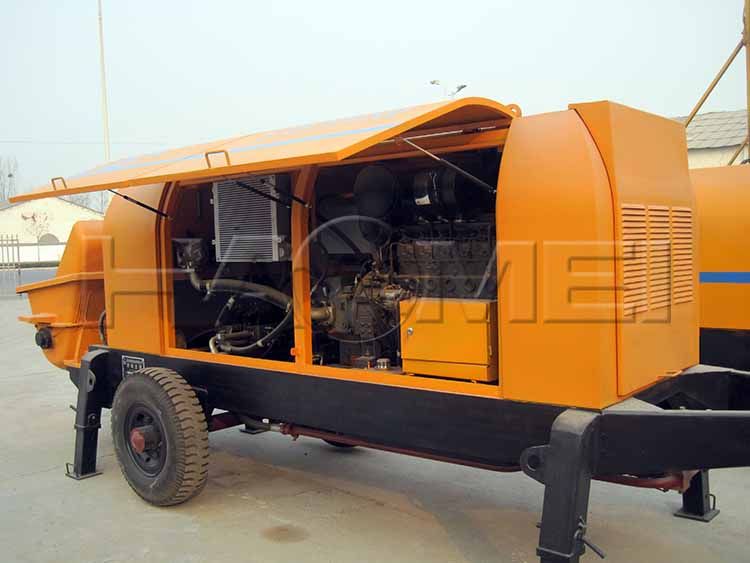
- Trailer-mounted pumps: Static equipment without independent mobility, requiring transport by trailer and fixed installation on-site. They are used with long-distance pipelines to pump concrete. With their simple structure and low purchase cost, they are a high-performance, cost-effective model suitable for special scenarios.
The core reason why boom pumps dominate the global rental market
From North American commercial building construction and European urban renewal to Middle Eastern mega-projects and Southeast Asian residential development, concrete pump truck rentals consistently far exceed trailer pump rentals. This global popularity stems from its three core advantages that meet the core needs of global construction: high efficiency, mobility, and compliance and safety.
1. Maximized construction efficiency, adaptable to tight global deadlines
Boom pumps completely eliminate the cumbersome pipeline laying, dismantling, and fixing processes required for trailer pumps, which often consume hours of preparation time. On most construction sites worldwide, boom pumps are more than 50% more efficient than truck mounted concrete pumps, reducing labor hours and ensuring on-time delivery of high-priority projects.
For medium to large-scale engineering projects (high-rise residential buildings, highways, airport hubs), this high efficiency makes boom pumps the preferred rental option for general contractors in various regions.
2. Mobile Compaction, Adaptable to Globally Dispersed Construction Sites
Global construction projects are generally characterized by dispersed locations and short construction periods, especially evident in rapidly developing urban areas. Boom pumps can move autonomously between sites without the need for additional flatbed trailers, allowing for simultaneous operations at multiple sites within a single day.
Concrete line pumps, on the other hand, rely on flatbed truck transport and on-site fixed installation, making them unsuitable for the dynamic rental needs prevalent globally, significantly reducing their practicality.
3. Strong Safety and Compliance, Adhering to Global Construction Standards
Strict safety regulations are enforced on construction sites worldwide. Boom pumps support remote control operation, keeping construction personnel away from the pouring area and significantly reducing safety risks such as falling objects and concrete splashes.
Furthermore, minimal manpower is required to monitor pipelines; a single person can perform core operations, reducing both labor costs and safety liability risks. Trailer concrete pumps require dedicated personnel to monitor pipelines and clear blockages throughout the process, resulting in higher labor costs and greater safety hazards—a drawback that most global rental companies strive to avoid.
4. Wide Scenarios Coverage, Adapting to Global Mainstream Construction Needs
The boom lengths ranging from 30 to 70 meters can cover almost all common construction scenarios worldwide: high-rise residential buildings, commercial complexes, bridge decks, municipal engineering, etc. This versatility makes it a core asset for multinational rental fleets, allowing for flexible deployment across different regions and projects without special modifications.
Trailer Pumps: An Indispensable Rental Option in a Niche Market
While the line pump truck for sale is not as popular as concrete boom pump truck overall, it remains essential equipment in specific global markets and operating conditions, perfectly filling market gaps that boom pumps cannot reach.
1. Extremely Low Rental Costs, Suitable for Projects with Limited Budgets
The daily rental and shift costs of trailer pumps are only 1/3 to 1/2 of those of boom pumps, with lower fuel consumption and maintenance costs. For small-scale rural projects, low-rise buildings, long-term fixed-point pouring in emerging markets, and scattered projects with tight budgets, trailer pumps offer significantly better value than boom pumps, making them the preferred choice for small and medium-sized engineering contractors.
2. Ultra-long-distance/high-lift pumping, suitable for mega-infrastructure projects
Trailer pumps utilize a high-pressure pumping system, enabling horizontal or vertical concrete delivery over hundreds of meters. They are essential equipment for projects such as super high-rise buildings, tunnel engineering, deep foundation pits, and cross-sea bridge pile foundations worldwide. Boom pumps, limited by boom extension length (typically 30-70 meters), cannot perform ultra-long-distance pumping, which is the core reason why trailer pumps are irreplaceable in major infrastructure projects.
3. Dedicated to site-constrained scenarios, operating even in confined spaces
Low urban alleys, muddy and soft ground, and construction sites with insufficient load-bearing capacity (especially common in historic European cities and densely populated areas of Southeast Asia) make it impossible for large boom pumps to access these locations. Trailer line pumps are compact, can be fixed in place, and can complete pouring through extended pipelines, making them the only optimal solution for space-constrained scenarios.
Original source: https://www.concrete-pump-cn.com/a/which-is-more-popular-in-rental-market-concrete-pump-trailer-or-concrete-pump-truck.html
Tags: concrete boom pump,
Previous: 36m Concrete Pump For Sale
Next: 32 Meter Concrete Pump