

 feedom@haomei-machinery.com

Concrete Mixer and Pumping Machine
Posted On: 24/11/2026 | Posted by: Haomei Concrete Pumps
A concrete mixer and pumping machine combines on-site batching, mixing, and concrete delivery through a pipeline. It can reduce dependence on ready-mix truck timing where access is restricted, pours are intermittent, or projects are distant from commercial batching plants.
The equipment is not automatically the lowest-cost choice. Its value depends on required daily volume, aggregate quality, crew capability, pipeline layout, and maintenance discipline. A machine selected only by advertised pumping output may suffer blockages, low utilization, or premature wear.
Match Capacity and Configuration to the Pour Plan
Start with the placement requirement, not the machine name. Calculate the volume needed per hour from the planned pour volume and the workable placing window. Then allow for setup, mixer charging, truck or loader supply, pipeline priming, cleaning, and normal production interruptions.
For example, a 40 m3 slab placed over four productive hours needs an average of 10 m3/h. Specifying a unit with only 10 m3/h theoretical output leaves no allowance for interruptions. The selected pumping and mixing capacity should support the planned rate with practical margin.
| Selection factor | What to verify | Common error to avoid |
|---|---|---|
| Required output | Actual placed m3/h, not only pump theoretical output | Selecting from maximum catalog output alone |
| Horizontal and vertical reach | Pipe length, elevation, bends, reducers, hose length | Ignoring pressure loss through bends and vertical risers |
| Aggregate size | Maximum aggregate must match the pump, valve, and pipeline limits | Using oversize or poorly graded aggregate |
| Mix design | Cementitious content, sand ratio, slump, admixtures, air content | Assuming every conventional mix is pumpable |
| Power source | Grid availability, voltage, diesel fuel logistics, emissions limits | Choosing diesel where local restrictions prevent its use |
| Mobility | Trailer, skid, or truck chassis; towing and site access | Underestimating turning space and ground bearing capacity |
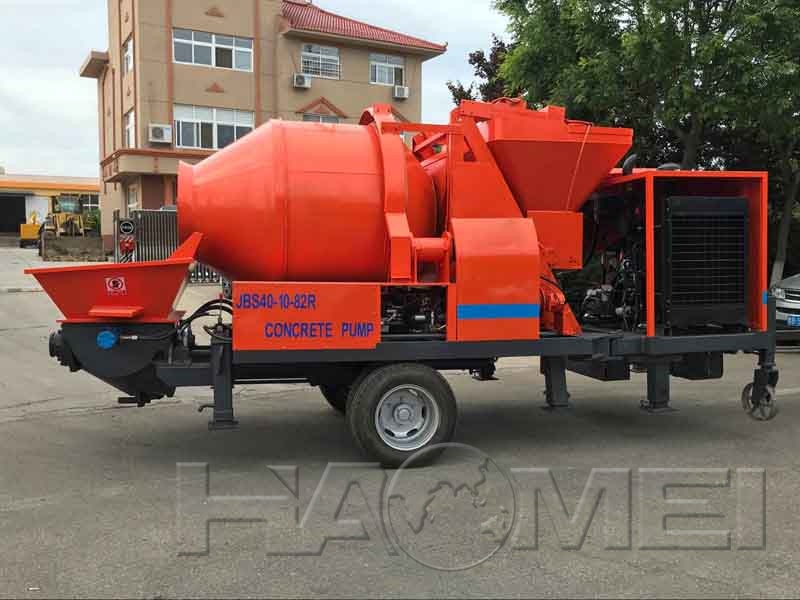
A Concrete Mixing Pump is often practical for dispersed low-rise work, rural construction, foundations, drainage structures, and small commercial projects. It is most effective when material supply can keep pace with the mixer and the pipeline can be installed with limited bends.
Use a trailer-mounted arrangement when the unit must move between pour locations or projects. A stationary setup can be preferable for repetitive production at a fixed site, provided aggregate stockpiles, water, cement handling, and truck access are organized around it.
Pumpability is a mix-design issue as much as an equipment issue. ACI 304.2R, Placing Concrete by Pumping Methods, identifies the importance of proper aggregate grading, adequate mortar volume, and consistent concrete quality. Require the concrete producer or site laboratory to confirm the mix is suitable for the intended line diameter and pumping distance. ASTM C143/C143M provides the standard test method for slump of hydraulic-cement concrete, but slump alone does not prove pumpability.
Use a Structured Ownership and Operating Cost Test
Do not compare purchase prices without calculating the production system around the machine. Capital cost is only one part of the decision. A lower-priced unit can become expensive if parts access is poor, fuel use is high, or it cannot maintain the planned placing rate.
Use this cost checklist before committing:
- Obtain written specifications for mixer volume, pump output, maximum aggregate size, maximum system pressure, and recommended line diameter.
- Request the engine emission stage, rated power, fuel consumption data at defined load conditions, and local compliance documents.
- Price wear items separately: pumping pistons, spectacle plate, cutting ring, S-valve or equivalent valve components, agitator parts, mixer blades, delivery pipe, couplings, and seals.
- Confirm local availability of trained technicians and genuine replacement parts.
- Include transport, commissioning, operator instruction, insurance, fuel, lubricants, washout management, and downtime in the financial model.
- Estimate annual operating hours realistically. Ownership is usually harder to justify when work is irregular and rental availability is reliable.
A useful comparison is cost per placed cubic meter:
Total annual ownership cost + annual operating cost + labor cost, divided by annual placed volume.
Use the same expected production assumptions for rental, subcontract pumping, ready-mix delivery, and self-production alternatives. Do not divide cost by theoretical machine capacity. Use measured placed volume after delays, cleaning, repositioning, and rejected batches.
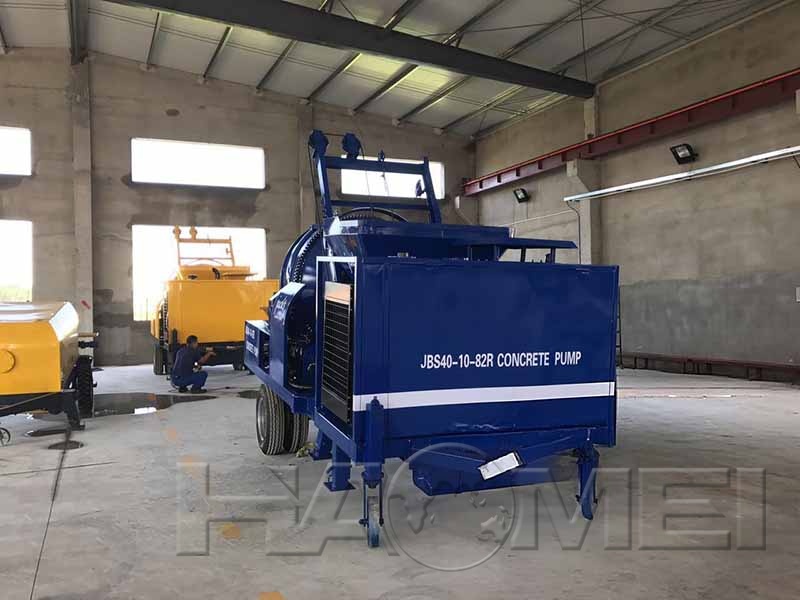
For remote work without dependable electricity, a Diesel Concrete Mixer Pump for Sale may provide operational independence. Check local diesel engine emission and noise requirements before purchase. In many jurisdictions, off-road engines, visible smoke, idling, and noise are regulated at national, regional, or site level.
Control Pumping Risks, Quality, and Digital Records
Concrete pumping involves stored pressure, moving machinery, suspended hoses, and alkaline wet concrete. Establish a documented pre-pour inspection and assign a competent person to coordinate the operation.
Before pumping, inspect pipe clamps, gaskets, hoses, couplings, outriggers, guards, hydraulic hoses, emergency stops, and communication methods. Confirm that the pipeline is supported and restrained, especially at elbows, risers, and terminal hose positions. Never stand in front of a discharge hose or attempt to open a pressurized pipeline.
In the United States, OSHA Subpart Q, 29 CFR 1926.700 through 1926.706, covers concrete and masonry construction requirements. OSHA also requires appropriate personal protective equipment under 29 CFR 1926 Subpart E. Wet concrete can cause chemical burns; gloves, eye and face protection, boots, and protective clothing must suit the exposure assessment. Outside the United States, apply the applicable local occupational safety law and machine standard. EN 12001 addresses safety requirements for concrete pumps and placing booms in markets using European standards.
Use this pre-pour sequence:
- Verify the approved mix, aggregate moisture condition, water addition limits, and admixture dosage.
- Check the line route and secure every connection before priming.
- Prime using the method approved by the machine manufacturer and mix supplier. Keep unsuitable grout or priming material out of structural concrete unless the project specification permits it.
- Start at a controlled rate. Monitor hopper level to prevent air entry and maintain continuous material flow.
- Stop immediately for abnormal pressure rise, pulsation, leakage, unusual noise, or segregation.
- Depressurize according to the manufacturer procedure before clearing any blockage or opening any coupling.
- Clean the mixer, hopper, valve, and pipeline promptly. Control washout so cementitious water does not enter drains or soil.
Digital records are increasingly valuable for fleet control. Track engine hours, pump strokes, fuel use, hydraulic oil temperature, pressure alarms, maintenance events, batch volumes, and location. These records help identify wear trends, compare operators and projects, schedule replacement parts, and support cost allocation.
For acceptance and quality control, record delivery or batching times, water additions, ambient conditions, slump test results where specified, cylinder or cube sampling records, and placement location. ASTM C94/C94M is widely referenced for ready-mixed concrete, while project specifications determine the applicable testing frequency and acceptance criteria.
When evaluating equipment demonstrations, require a production test with the intended aggregate, target mix, representative pipeline length, and normal loading method. The most useful result is stable placed concrete volume per hour, with measured fuel use and no line blockage, rather than an unloaded catalog rating.
Original source: https://www.concrete-pump-cn.com/a/concrete-mixer-and-pumping-machine.html
Tags: Concrete Mixer and Pumping Machine, Concrete Mixing Pump,
Previous: Concrete Mixer And Pump For Sale
Next: