

 feedom@haomei-machinery.com
Concrete Pump Truck Reach
Posted On: 31/03/2026 | Posted by: Haomei Concrete Pumps
Potential equipment purchasers often search one phrase first: concrete pump truck reach. In the last three months, the most discussed questions on Google, Quora, and contractor forums have focused less on brochure numbers and more on real jobsite limits. The issue is simple. A pump may look long on paper, yet actual placing distance depends on boom design, setup room, hose handling, slab height, and obstructions.
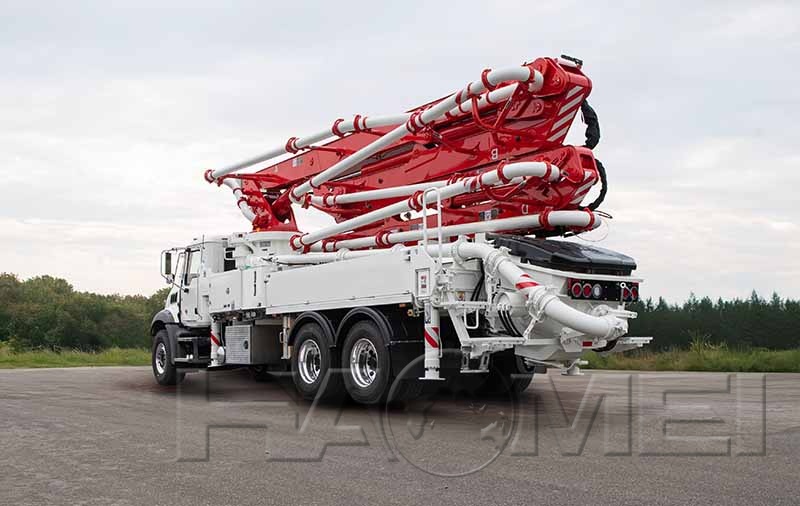
Below are 5 hot questions that reflect what real people have been asking recently, with practical answers written for companies comparing new machines.
Hot Questions About Concrete Pump Truck Reach
| Hot question | What people really want to know | Short answer |
|---|---|---|
| How far can a concrete pump truck really reach? | Real working distance, not brochure claims | It depends on vertical reach, horizontal reach, unfolding room, and end hose use. |
| Is a 47m pump enough for most mid-rise jobs? | Whether a common size covers most projects | For many residential towers, commercial slabs, and bridge sections, yes, if site access is good. |
| What reduces boom reach on site? | Why actual reach feels shorter than rated reach | Tight outriggers, walls, trees, power lines, and awkward truck positioning are major factors. |
| How do I choose between 42m, 47m, and 52m reach? | Which size gives the best fit for budget and job mix | Match boom size to your most frequent pours, not your rarest extreme job. |
| Does longer reach always mean better value? | Whether larger pumps produce higher returns | Not always. Bigger units cost more, weigh more, and can be less efficient on smaller sites. |
1. How far can a concrete pump truck really reach?
This is the most common question because rated boom length can be misunderstood. A concrete pump truck reach figure usually refers to the boom class, such as 42m, 47m, or 52m. But the real placing distance is affected by three separate dimensions:
- Vertical reach, for upper floors or tall walls.
- Horizontal reach, for wide slabs or long foundations.
- Reach depth, for lower-level pours such as pits or basement work.
In practice, actual reach is rarely identical to the headline number. The boom geometry, the number of sections, and the articulation style all change how far the tip can move efficiently. A machine with a smart folding pattern may work better in confined areas than a technically longer boom with poor unfolding angles.
For example, a contractor comparing a 42m Concrete Pump Truck with a larger machine should not look only at the maximum figure. They should also ask how much working room is needed behind and beside the truck, and whether the boom can place concrete over a roof edge, retaining wall, or interior courtyard without repeated repositioning.
2. Is a 47m pump enough for most mid-rise jobs?
This has become a very active question because 47m units sit in a popular middle range. They are often seen as a practical balance between reach, mobility, and cost. For many contractors handling apartment buildings, factory floors, podium slabs, and standard commercial structures, a 47m machine can cover a large share of daily work.
The reason is not just boom length. A 47m class pump is often easier to deploy than ultra-long boom models on urban sites. It can provide strong vertical and horizontal coverage while avoiding some of the transport, axle load, and setup challenges that come with larger equipment.
If your work regularly involves six- to twelve-story structures, parking decks, and medium-span industrial pours, this size often enters the shortlist first. A product such as the 47m Concrete Pump Truck for sale is usually considered by firms that want broad project flexibility without stepping into the longest-boom category.
That said, if your projects frequently include deep setbacks, tower podiums, or difficult obstacle clearance, the extra reach of a 52m or longer machine may still save labor and setup time.
3. What reduces boom reach on site?
This question matters because many first-time purchasers assume boom reach is fixed. On a real project, several factors can shorten effective placing distance.
Common reach reducers
| Factor | How it affects reach |
|---|---|
| Limited outrigger extension | Can restrict safe boom movement and working envelope |
| Poor truck position | Forces the boom to work at inefficient angles |
| Power lines or trees | Block ideal boom unfolding and tip movement |
| Adjacent buildings | Reduce horizontal sweep and overhead access |
| Long end hose handling | Adds flexibility but may reduce precision at the far edge |
| Weak site ground | May limit the safest placement location for the truck |
A longer boom is useful only if the truck can be set up in the correct spot. This is why experienced fleet managers review site drawings before selecting a boom class. Sometimes a shorter unit with easier access delivers concrete faster than a larger model trapped in a poor setup position.
4. How do I choose between 42m, 47m, and 52m reach?
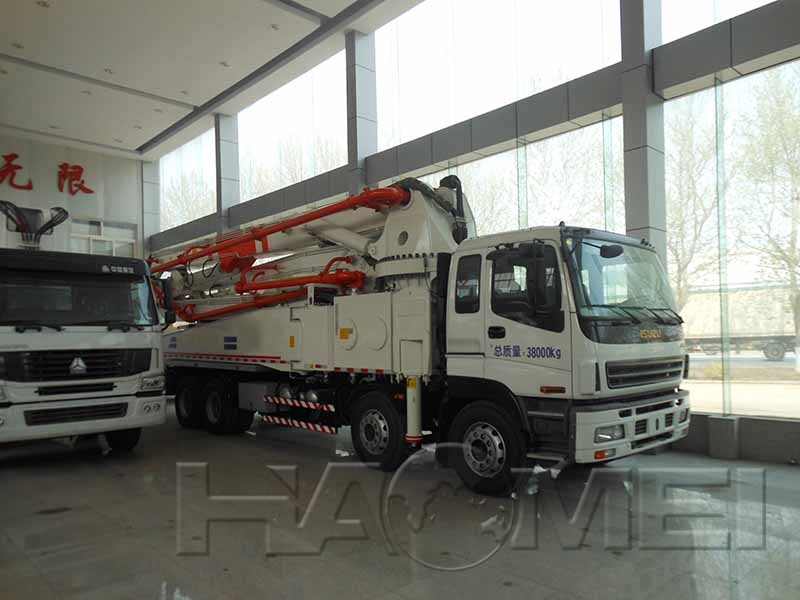
This is one of the most commercially important questions because it directly affects capital cost and utilization rate. The best choice depends on your most common projects.
A simple sizing view
| Boom class | Best fit for | Main advantage | Main caution |
|---|---|---|---|
| 42m | Low- to mid-rise buildings, standard foundations, municipal work | Good balance of access and cost | May be limiting on larger footprint jobs |
| 47m | Mid-rise residential, commercial slabs, versatile urban work | Strong all-around flexibility | May still fall short on highly obstructed sites |
| 52m | Larger commercial projects, taller structures, wider pours | Greater coverage, fewer reposition moves | Higher purchase cost and site demands |
A smart purchasing approach is to review the last 20 to 30 pours your company completed. Measure how often crews needed extra pipeline, secondary placement, or truck repositioning because the boom could not cover the area efficiently. That historical pattern usually tells you more than a single future dream project.
Some companies also compare standard truck-mounted options with a dedicated Boom Pump lineup when they want to expand reach capability across different project types.
5. Does longer reach always mean better value?
No. This is an increasingly common question because many new equipment shoppers worry about underbuying. The truth is that oversizing can be expensive. A longer concrete pump truck reach may improve coverage, but it also tends to increase purchase price, maintenance demands, fuel use, and transport considerations.
Value comes from matching machine capability to revenue-producing work. If 70 percent of your pours are low-rise residential or short-reach industrial placements, a very long boom may spend most of its life underused. On the other hand, if your crews lose hours every week repositioning smaller pumps, paying for extra reach may be financially sound.
When longer reach pays off
- Jobsites have restricted access and fewer setup options.
- Projects involve taller forms or broader slab footprints.
- Reducing truck moves improves pour speed and crew safety.
- Premium projects support higher equipment utilization.
When a smaller unit may be the better fit
- Most pours are routine and accessible.
- Transport flexibility matters more than maximum reach.
- Site entry, turning radius, or road limits are a concern.
- Budget discipline favors faster payback over top-end capacity.
What new equipment shoppers should ask suppliers
When discussing concrete pump truck reach with a manufacturer or exporter, ask for these details instead of only the boom headline number:
- Rated vertical reach and horizontal reach.
- Unfolding height and minimum setup space.
- Outrigger width in full and restricted modes.
- Boom section design and folding type.
- Chassis dimensions and total operating weight.
- Recommended applications by project type.
- Spare parts availability, especially wear parts and hydraulic components.
These questions help you compare machines on real job value instead of marketing language alone. For new equipment purchasers, the best reach is not simply the longest one. It is the one that lets your crew place concrete safely, quickly, and repeatedly on the jobs you win most often.
Original source: https://www.concrete-pump-cn.com/a/concrete-pump-truck-reach.html
Tags: concrete pump truck reach, concrete boom pump, boom length, vertical reach, horizontal reach,
Previous: 32 Meter Concrete Pump
Next: 58m Concrete Pump