

 feedom@haomei-machinery.com
Cement Boom Truck
Posted On: 21/04/2026 | Posted by: Haomei Concrete Pumps
Potential users often search for "cement boom truck" when they actually mean a concrete boom pump truck. The hottest questions focus on reach, output, cost, and whether one machine fits both small and large pours. The answers below are written for people comparing new equipment and trying to avoid an expensive mismatch.
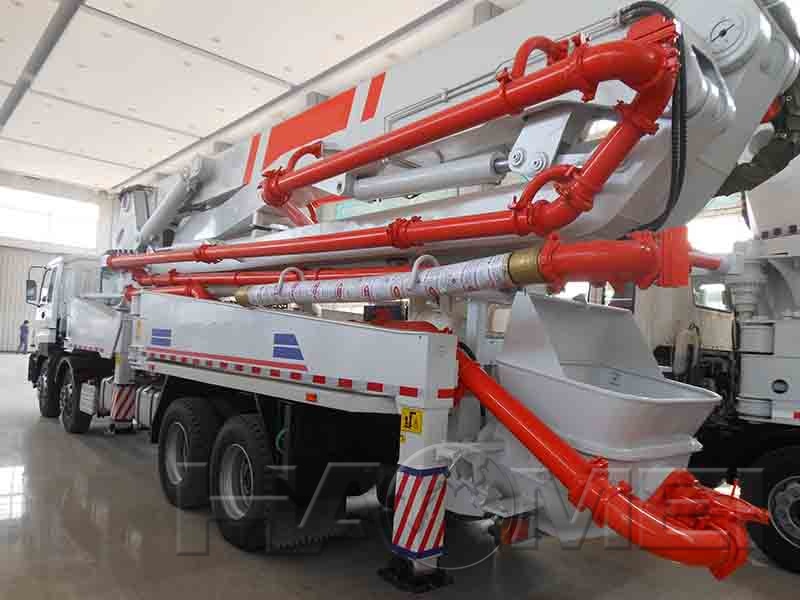
1. What is the difference between a cement boom truck and a concrete boom pump truck?
This is one of the most common questions because the term "cement boom truck" is widely used in search, even though the machine pumps concrete, not cement alone. Cement is only one ingredient in concrete. A boom pump truck carries a placing boom and pumping system that moves wet concrete through pipeline sections to the pour point.
For a new machine shopper, the practical difference is not vocabulary. It is machine capability. A true concrete boom pump truck is selected by boom length, pump output, chassis strength, and jobsite access. If your projects include slabs, footings, columns, walls, bridge decks, or mid-rise structural work, a truck-mounted pump can reduce manual handling and speed up placement.
If you are comparing sizes, a standard Boom Pump is usually the right starting point for general commercial and residential work. If your upcoming projects involve taller structures or wider placing radiuses, a larger unit such as a 47m Concrete Pump Truck for sale may fit better than a short-boom model.
2. What boom length do I need for my jobs?
This question is hot because many first-time equipment purchasers focus too much on maximum height and not enough on real site geometry. A longer boom is not automatically the smarter choice. What matters is whether the truck can set up safely and place concrete without constant repositioning.
A short answer is this:
| Project type | Common boom range | Why it fits |
|---|---|---|
| Small residential slabs and low-rise work | 20 m to 32 m | Easier setup, lower cost, good for tighter access |
| General house foundations and medium commercial pours | 33 m to 39 m | Balanced reach and maneuverability |
| Larger commercial structures | 40 m to 47 m | Better horizontal reach and less truck movement |
| High-rise or wide placement zones | 48 m+ | Covers complex pours and elevated delivery points |
Two extra points matter more than many shoppers expect. First, horizontal reach often affects productivity more than vertical reach. Second, outrigger footprint can limit the use of a large boom on urban sites.
If your work is mostly in dense neighborhoods, a 47 m machine may look attractive on paper but become frustrating on narrow streets. On the other hand, if you routinely pour large raft foundations or elevated decks, a small unit can cost more in labor and setup time than the savings in purchase price.
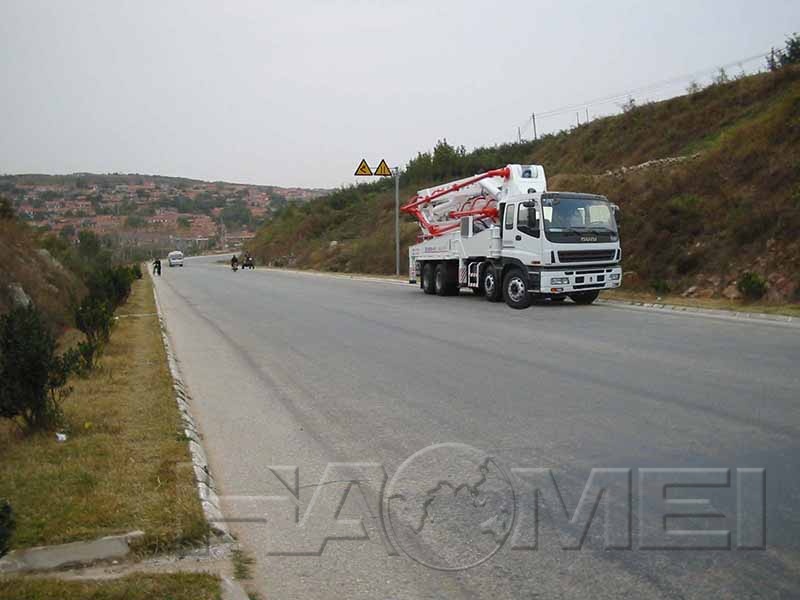
3. How much concrete can a cement boom truck pump per hour?
This question appears frequently because quoted output figures can be misleading. Manufacturers often list theoretical pumping capacity, but field output depends on mix design, line pressure, boom movement, operator skill, site organization, and how consistently the mixer trucks arrive.
For many truck-mounted units, theoretical output may range from roughly 90 m3/h to 180 m3/h or more. Real-world output is usually lower. On a smooth, well-planned pour with pumpable mix and steady truck supply, performance can stay strong. On congested sites with stop-start delivery, actual productivity can drop sharply.
A realistic planning approach is to ask these five things before choosing a machine:
| Question | Why it matters |
|---|---|
| What slump and aggregate size will be used most often? | Pumpability changes pressure demand |
| How long is the average pour? | Larger pumps make more sense on sustained volume |
| How far horizontally will material travel? | Distance affects line resistance |
| Will jobs be continuous or stop-start? | Interruption reduces practical output |
| How reliable is concrete truck scheduling? | Pump speed is useless without supply |
For new equipment selection, do not chase the highest output number alone. Match the pump to your normal mix, not your best-case mix. That usually leads to fewer blockages, less wear, and better fuel efficiency.
4. How much does a new cement boom truck cost, and what affects the price most?
This is one of the hottest commercial questions because pricing varies dramatically. New truck-mounted pumps can differ in cost based on boom length, chassis brand, hydraulic system, pumping unit, remote control package, emission standard, and local compliance requirements.
In simple terms, the biggest price drivers are:
Boom length and structural design.
Chassis brand and axle configuration.
Pumping capacity and pressure rating.
Hydraulic and electrical component brands.
Spare parts availability and service support.
A lower initial price is not always a lower ownership cost. New shoppers should pay attention to wear parts, pipe life, hopper wear plate life, and how fast replacement components can be sourced. Downtime during peak concrete season can cost far more than the difference between two quotations.
Ask suppliers for a full cost picture, including commissioning, operator training, spare parts package, and warranty terms. A machine that arrives cheaper but lacks service readiness may become expensive very quickly.
5. Is a cement boom truck suitable for small jobs, or is it only for large commercial pours?
This question has become more common as contractors try to use one machine across more project types. The answer depends less on project size alone and more on access, pour frequency, and labor efficiency.
A boom pump truck can be highly effective on smaller pours when:
The site has limited wheelbarrow access.
The pour location is behind obstacles or over structures.
Labor costs are high.
Fast setup reduces neighborhood disruption.
Quality placement matters more than raw volume.
However, it may be oversized for very small or highly irregular jobs where setup time outweighs pumping benefits. In those cases, a smaller truck-mounted unit or another pumping method may be more economical.
For mixed workloads, many first-time purchasers do best with a mid-range machine rather than an extreme. It gives enough reach for commercial work without becoming too restricted on urban or residential projects. That is why models in the middle boom classes are often the most practical first investment.
What should you ask a supplier before placing an order?
Since many hot Q&A threads stop at general advice, here are direct purchase-stage questions worth asking suppliers:
| Supplier question | What a strong answer should include |
|---|---|
| What is the real working reach, not just nominal boom length? | Vertical and horizontal figures, unfolding space |
| What mix designs does this pump handle best? | Slump range, aggregate size, pressure details |
| What is the outrigger footprint? | Setup dimensions for tight jobsites |
| What wear parts are included? | Pipes, elbows, wear plates, cutting ring details |
| How fast are parts supplied? | Local stock or confirmed lead time |
| What training is included? | Operator and maintenance training scope |
These questions usually tell you more than a brochure does. A serious supplier should be able to explain not only what the machine can do, but where it works poorly. That honesty is useful when your goal is choosing equipment that will stay productive across changing job conditions.
Original source: https://www.concrete-pump-cn.com/a/cement-boom-truck.html
Tags: cement boom truck, concrete boom pump truck, boom pump, concrete pump truck for sale,
Previous: Small Concrete Pump for Sale
Next: Concrete Pump Trailer