

 feedom@haomei-machinery.com
Boom Pump for Sale
Posted On: 13/10/2026 | Posted by: Haomei Concrete Pumps
Interest in a boom pump for sale often starts with a simple question about price, but equipment selection depends on far more than the truck's boom length. Recent discussions across Google searches, construction forums, and Q&A communities show that contractors are comparing reach, output, chassis suitability, operating costs, and parts support before placing an order.
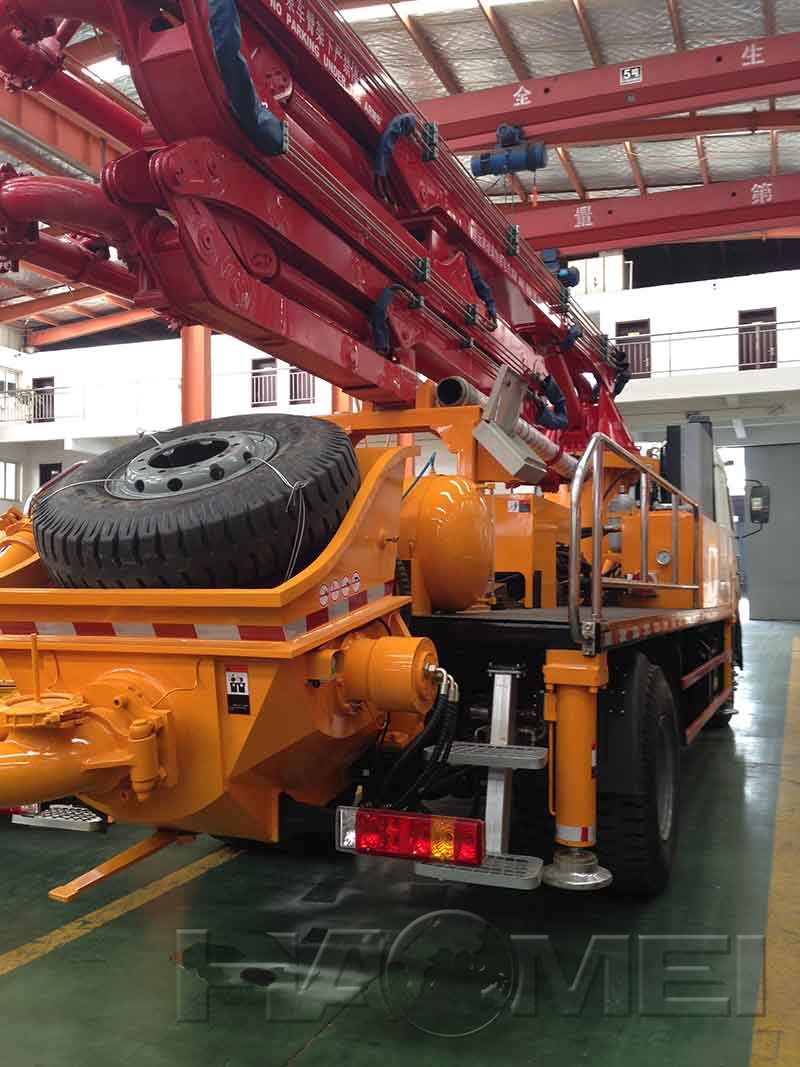
The following five questions reflect the issues most frequently raised by companies considering a new concrete pump truck for residential, commercial, and infrastructure pours.
1. What boom length do I actually need for my projects?
A longer boom is not automatically the better option. The right length depends on the typical distance from the legal truck parking position to the furthest placement point, plus height, obstacles, and required working angle. A 32 m to 38 m pump commonly suits low-rise housing, smaller commercial sites, and narrow urban locations. A 42 m to 47 m model provides more flexibility for mid-rise structures and larger slabs. Pumps above 52 m are generally chosen for major commercial work, industrial projects, and sites where the truck must remain well away from the pour area.
Do not select solely by nominal vertical reach. Ask for the horizontal reach diagram and compare it with real jobsite layouts. Outriggers also need clear space, so a large boom may be impractical where access roads are tight or neighboring structures limit setup.
| Typical Project Type | Often Suitable Boom Range | Important Site Factor |
|---|---|---|
| Villas and low-rise homes | 20 m to 36 m | Street width and setup space |
| Commercial slabs and warehouses | 36 m to 47 m | Horizontal placement distance |
| Mid-rise buildings | 42 m to 56 m | Vertical reach and pipeline planning |
| Large infrastructure work | 52 m to 65 m | Stability, access, and cycle volume |
For work that regularly includes medium-sized commercial pours, a 42m Concrete Pump Truck can offer a practical balance between reach, maneuverability, and transport dimensions.
2. How much does a new boom pump for sale cost, and what changes the price?
The purchase price is affected by boom size, chassis brand, pumping system output, emissions configuration, control technology, and optional equipment. A compact boom pump generally costs less than a long-boom truck, but the lower initial price can be offset if it cannot reach enough projects without extra pipeline, repositioning, or rental support.
When comparing quotations, confirm whether each offer includes the same items. Delivery pipes, end hoses, remote controls, hopper grates, wear parts, winterization features, and commissioning can vary between suppliers. Chassis specifications matter as well. Engine power, axle arrangement, cab equipment, local road compliance, and spare-tire provisions all influence the delivered machine cost.
A useful comparison method is to divide the total ownership estimate by expected annual pumped cubic meters. Include finance cost, insurance, fuel, operator wages, maintenance, wear components, and anticipated downtime. This turns a price comparison into an operating-capacity comparison.
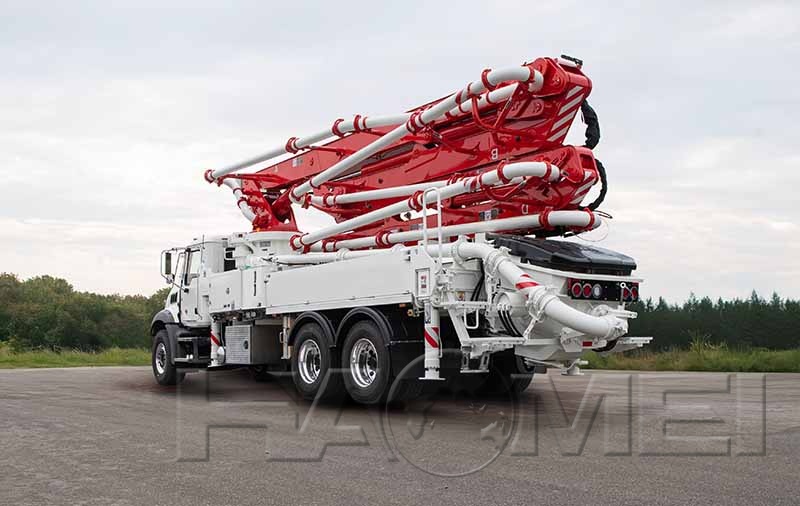
3. Should I prioritize pumping output or boom reach?
Neither specification should be considered alone. Boom reach determines where concrete can be placed, while theoretical output indicates how quickly the pump can move material under favorable conditions. Actual output is usually lower than the brochure figure because concrete mix design, slump, line diameter, boom geometry, ambient temperature, and operator technique all affect flow.
For ready-mix supply with steady truck arrivals, higher output can reduce waiting time and improve pour continuity. However, an oversized output rating is less useful if the project usually has limited delivery capacity or requires slow, controlled placement around reinforcement.
Ask the manufacturer for performance data at different pressures, not just maximum cubic meters per hour. Also verify cylinder diameter, stroke rate, maximum concrete pressure, valve type, and compatible aggregate size. These details show whether the machine matches the concrete mixes commonly supplied in your area.
4. Can the pump truck operate safely on small or uneven jobsites?
A boom pump needs more than a level area large enough for the truck. It needs stable ground beneath every outrigger, safe clearance from excavations, overhead power lines, walls, and traffic routes, plus an approach route that can support the chassis weight.
Before ordering, request the machine's full setup drawing. This should show outrigger spread, minimum setup width, support loads at each outrigger, boom unfolding clearance, vehicle dimensions, and gross vehicle weight. A contractor working on constrained urban sites may benefit more from a compact multi-section boom than from a longer model with wider outrigger demands.
Create a site-assessment checklist for dispatch staff: ground condition, slope, underground utilities, access width, concrete truck standing area, power-line location, and washout arrangements. Reviewing these points before the truck travels can prevent aborted setups and expensive delays.
5. What service support and wear parts should be confirmed before ordering?
A new concrete pump truck is productive only when routine maintenance items can be obtained quickly. Wear is expected in the delivery system, especially in the spectacle plate, cutting ring, S-valve area, wear plates, pipes, elbows, clamps, hopper components, and agitator system. The rate of wear changes with pumping hours, pressure, aggregate type, and cleaning discipline.
Ask the supplier for a recommended maintenance schedule, warranty scope, technician response process, remote diagnostic capability, and a list of fast-moving consumables. It is sensible to keep common service components on hand rather than waiting for a part after a failure occurs. Access to Concrete Pum Truck Parts in Stock can reduce disruption during peak pouring periods.
| Service Question | Why It Matters |
|---|---|
| Is local technician support available? | Faster diagnosis and commissioning assistance |
| Which wear parts should be stocked? | Reduces downtime from normal pumping wear |
| Is operator training included? | Helps prevent avoidable misuse and poor cleaning |
| What does the warranty exclude? | Clarifies coverage for hydraulic, chassis, and wear items |
| Are manuals supplied in English? | Supports daily inspections and safe operation |
A well-specified machine should match your normal mix designs, access conditions, production targets, and local service capability. Request a documented technical configuration before signing, including chassis details, boom geometry, hydraulic performance, standard accessories, warranty terms, and delivery acceptance procedures.
Original source: https://www.concrete-pump-cn.com/a/boom-pump-for-sale.html
Tags: boom pump for sale, concrete boom pump, concrete pump truck,
Previous: 39m Concrete Pump
Next: