

 feedom@haomei-machinery.com
Concrete Boom Pump For Sale
Posted On: 11/02/2026 | Posted by: Haomei Concrete Pumps
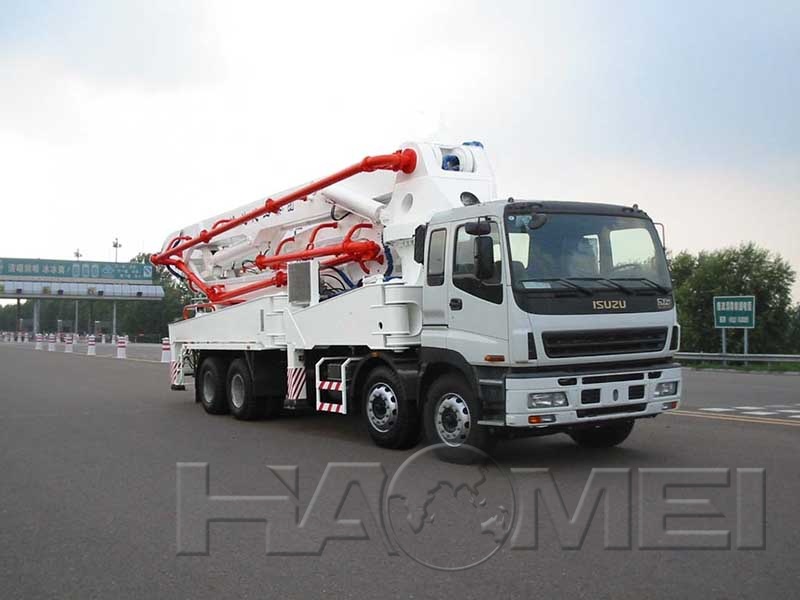
People searching for a concrete boom pump for sale tend to ask the same practical questions across Google and Q&A communities: real pricing ranges, what boom length actually fits their jobs, how to avoid costly spec mistakes, and what ownership looks like after delivery. Below are five of the most asked questions and straight, experience-based answers tailored to potential first-time owners of new pumping equipment.
1) How much does a new concrete boom pump cost in 2025, and what drives the price most?
A new concrete boom pump price is usually driven less by one headline number and more by the combination of boom length, chassis class, pumping group, and options that affect reliability and resale.
Main price drivers to expect:
Boom length and boom structure. Longer booms need stronger steel, more sections, and higher stability requirements.
Chassis and axle configuration. Heavier booms typically require more axles, which affects registration, tires, and long-term running costs.
Output and pressure. Higher theoretical output and high-pressure pumping packages matter if you pump stiff mixes, line pump long distances, or do high-rise work.
Core components. The brand and spec of hydraulics, main pump, and wear parts package can change the total cost significantly.
Options. Remote control, centralized lubrication, stronger outriggers, hopper safety grating, and cold-weather packages can be worth it if your job mix demands them.
A quick way to keep pricing comparable is to request quotes that list: boom length, axle count, maximum vertical and horizontal reach, theoretical output, maximum pressure, pipeline diameter, and standard wear parts included.
2) What boom length should I choose, 32m, 42m, 47m, 52m, or 65m, for typical building sites?
Boom length selection is mostly about jobsite geometry, not just building height. Many first-time owners underestimate setup constraints and overestimate how often they will use full reach.
Think in these terms:
Vertical reach is not the same as placing height. You lose reach when you must set up farther away due to obstacles, soft ground, or access limits.
Horizontal reach matters on wide slabs and podiums. If your work includes large footprints, a slightly longer boom can reduce repositioning.
Setup space. Longer booms often need larger outrigger spread and better ground bearing capacity.
If your work centers on mid-rise residential and mixed commercial, a 42m to 52m class is commonly versatile. For a focused spec, compare a 47m Concrete Pump Truck for sale against a 52m class machine when you want stronger reach without jumping into the higher transport and setup demands of 60m-plus.
If your schedule regularly includes tall core walls, long-reaching placements from limited access points, or complex site obstacles, a 65 Meter Concrete Pump Long Boom may fit, but only if your sites can support the outrigger loads and you can manage transport rules for that size.
3) Is it better to buy a new boom pump or rent at first, and what utilization makes buying make sense?
This question comes up constantly because the risk is not just the purchase price, it is utilization and downtime. Renting makes sense when your pumping schedule is irregular, or when your jobs vary so widely that one boom length will not cover most placements.
Buying becomes attractive when:
You can keep the unit working consistently across your pipeline of pours.
You control scheduling and do not want to lose days waiting for rental availability.
You have operators lined up or can train and retain them.
A simple rule of thumb is to estimate annual pumping hours and compare:
equipment payment or capital cost,
operator cost,
fuel and consumables,
wear parts and planned service,
and realistic downtime.
If your forecast depends on a few peak months only, renting or partnering can reduce risk. If you have steady weekly pours, ownership often improves schedule control and margin stability.
4) What specs should I check to avoid buying the wrong concrete boom pump for my mix designs and pours?
Most spec mistakes come from focusing on boom length and ignoring the pumping group. To avoid a mismatch, match the machine to your toughest common pour, not your easiest.
Specs that matter on day one:
Maximum pressure. Important for high-rise, long pipeline, or stiff mixes.
Theoretical output versus real output. Real output depends on concrete, site logistics, and operator rhythm.
Pipeline diameter and reducer compatibility. Affects blockage risk and wear.
Hopper design and agitator. Impacts feeding consistency.
Boom type and folding. Z-fold vs R-fold affects placement in tight spaces.
Use this quick comparison checklist when reviewing quotes.
| What to Check | Why It Matters | What to Ask the Seller |
|---|---|---|
| Max pressure and hydraulic system | Prevents stall and slow pumping on hard jobs | Pressure rating, main pump brand, hydraulic cooling |
| Output range | Impacts cycle time and crew efficiency | Theoretical vs typical output on your mix |
| Boom folding style | Controls access around rebar, walls, and overhead constraints | Z boom or R boom recommendation for your sites |
| Outrigger span and load | Determines where you can legally and safely set up | Outrigger footprint, ground bearing guidance |
| Wear parts package | Predicts early maintenance spend | Wear plate, cutting ring, delivery line, clamps included |
5) What maintenance items will I be paying for most often, and how can I reduce downtime?
The fastest way to lose money with a boom pump is not fuel, it is unplanned downtime caused by wear part neglect and poor cleaning discipline.
Common recurring items:
Wear plate and cutting ring. These are normal wear items, and replacement timing depends on mix abrasiveness and pumping hours.
Delivery lines and elbows. Elbows wear fastest on high-output work and abrasive aggregates.
Seals, filters, and hydraulic oil management. Keeping oil clean and cooling effective extends component life.
Downtime reduction practices that actually work:
Keep a basic spares kit on hand: clamps, gaskets, a few common elbows, cleaning balls, and critical sensors.
Train operators on shutdown cleaning routines, especially after stiff or fiber mixes.
Track wear by hours and cubic yards, not just by calendar time.
If you plan to run the unit hard, it is smart to confirm local availability of essential consumables and service support before delivery.
A practical buying checklist you can use during quotes
Confirm your most common placement heights and the worst access constraints on your sites.
Match boom length to setup reality, including outrigger space and ground bearing.
Match pumping pressure to your toughest mix and longest pipeline scenario.
Ask what wear parts are included and what the first 500 hours typically require.
Request a commissioning and operator training plan so the first pours are stable.
These questions will narrow your choices quickly and help you compare like-for-like when evaluating a concrete boom pump for sale across different suppliers.
Original source: https://www.concrete-pump-cn.com/a/concrete-boom-pump-for-sale.html
Tags: concrete boom pump for sale, boom pump price, concrete pump truck,
Previous: 36 Meter Concrete Pump
Next: Concrete Mixer Machine With Pump