

 feedom@haomei-machinery.com
Boom Pressure Concrete Pump
Posted On: 07/05/2026 | Posted by: Haomei Concrete Pumps
A boom pressure concrete pump is not selected by boom length alone. The real decision is whether the machine can place the specified mix at the required height, distance, and rate without unsafe setup pressure, hose blockages, or excessive wear.
For equipment purchasers, the term pressure should be read as concrete delivery pressure at the pumping system and pipeline. It is different from hydraulic system pressure, boom load capacity, or outrigger bearing pressure. Always verify the OEM data plate and model specification sheet before comparing units.
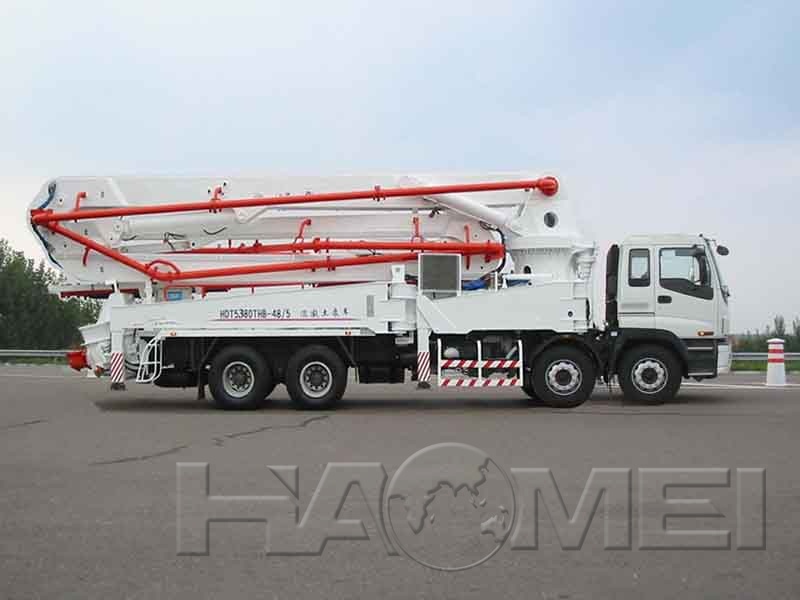
What pump pressure means on site
Concrete pressure is usually stated in bar, MPa, or psi. A useful conversion is 1 bar = 0.1 MPa = 14.5 psi. Many truck-mounted boom pumps on the market publish maximum concrete pressure in the general range of about 70 to 120 bar, but the exact figure depends on cylinder diameter, stroke, hydraulic circuit, valve type, and high-pressure or high-volume configuration.
Do not treat maximum pressure as normal working pressure. Running near the limit for long periods increases heat, wear plate stress, cutting ring wear, pipe abrasion, and blockage risk.
Fresh concrete density is often around 2,300 to 2,400 kg/m3. Vertical lift alone creates static head pressure of about 0.023 to 0.024 MPa per meter before friction is added. Friction loss depends on line diameter, aggregate grading, cement paste volume, admixtures, slump, bends, reducers, hose length, and pumping speed. ACI 304.2R, Placing Concrete by Pumping Methods, is a recognized reference for pumpability and placement practice. ASTM C143/C143M is widely used for slump testing, but slump by itself does not prove pumpability.
| Job condition | Pressure demand | Selection action |
|---|---|---|
| Low-rise slab with short boom reach | Low to moderate | Prioritize setup footprint, fuel use, and service access. |
| 8 to 20 story structure | Moderate to high | Check vertical head, delivery line plan, and reserve pressure. |
| Long horizontal pipeline after the boom | High friction risk | Increase pipe diameter where practical and confirm mix design. |
| Harsh or gap-graded aggregate | Blockage risk | Request trial pumping or supplier confirmation for the mix. |
| High output placement | Heat and wear risk | Balance m3/h output against sustainable pressure, not peak pressure. |
Selection checklist for reach, pressure, and compliance
Start with the pour map, not the catalog. Mark the farthest point, vertical height, obstacle positions, power lines, outrigger zone, road access, and washout area. Then select boom class and pressure capacity.
For urban commercial slabs, a 42m Concrete Pump Truck is often a practical middle class because it can cover many medium-rise and site-access scenarios without the road and setup burden of very long booms. Large infrastructure, towers, and wide raft pours may justify a 65 Meter Concrete Pump Long Boom, but only when outrigger space, axle regulations, and utilization support the cost.
| Boom class | Typical use case | Advantages | Risks to check |
|---|---|---|---|
| 20 to 37 m | Residential, tight yards, small commercial pours | Lower purchase cost, easier access, lower weight | Limited reach can force line dragging and labor cost. |
| 38 to 47 m | General commercial work, podiums, mid-rise | Strong utilization potential across varied sites | Must verify pressure reserve for vertical work. |
| 48 to 56 m | Large slabs, bridges, industrial sites | Fewer repositioning moves, higher productivity | Higher outrigger loads, insurance, inspection, and wear cost. |
| 60 m and above | Infrastructure and high-reach specialist work | Premium rental potential on suitable projects | Limited sites can accept the setup footprint and transport limits. |
Use this pre-purchase process:
- Confirm the design envelope. Record maximum vertical reach, horizontal reach, boom unfolding height, and the longest expected pipe or hose run.
- Match output to crew capacity. A pump rated at high output is wasted if the batch plant, trucks, finishers, and formwork cannot keep pace.
- Check pressure reserve. Ask the supplier for concrete pressure at rod side and piston side if both modes are available. Confirm the chosen mode does not reduce output below the pour plan.
- Verify chassis legality. Check gross vehicle weight, axle loads, bridge laws, registration class, and road permits in the operating region.
- Review safety standards. In the US, OSHA 29 CFR 1926.1400 excludes concrete pumps from the crane standard when used to deliver material through a pipe, but employers still must control electrical, struck-by, caught-in, and hose-whipping hazards under applicable OSHA rules and manufacturer instructions. ASME B30.27 covers material placement systems. In Europe, EN 12001 is the major safety standard for concrete conveying, spraying, and placing machines.
- Inspect the boom. Request inspection history, boom thickness testing where applicable, weld repair records, remote-control function tests, and emergency stop verification.
- Test the wear system. Measure wear plate, cutting ring, delivery cylinders, S-valve, spectacle plate, agitator, and hopper grate condition.
- Confirm parts support. A cheaper machine with slow parts supply can lose more money in downtime than it saves at purchase.
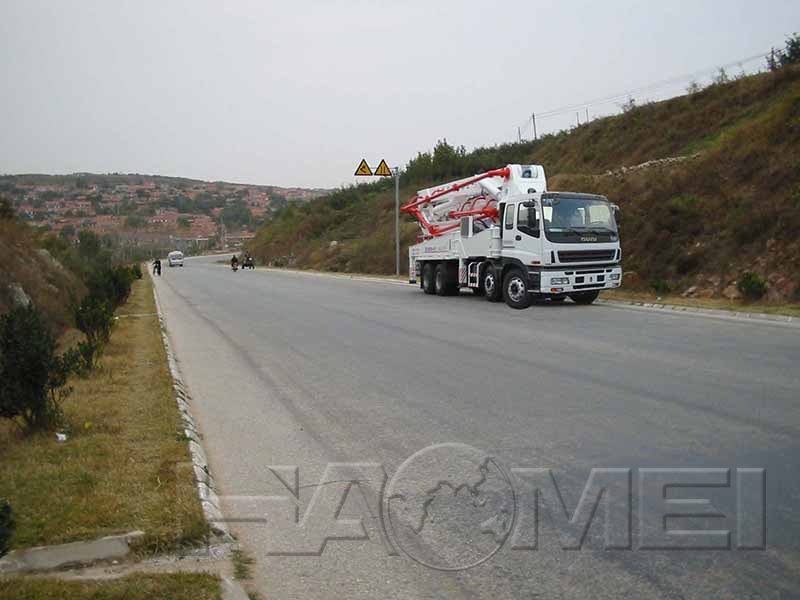
Cost, investment checks, and market trends
Public listings on auction and equipment marketplaces such as Ritchie Bros. and MachineryTrader show wide price variation. Age, boom length, hours, pump cell condition, emissions specification, brand support, and inspection status can change value sharply. As a planning benchmark, older smaller used boom pumps may be advertised under US$150,000, many used 40 to 52 m machines appear in broad bands from the low hundreds of thousands to above US$500,000, and late-model long-boom units can reach or exceed seven figures. Treat these as market bands to verify against live listings and independent inspection, not as appraisal values.
| Purchase route | Best fit | Financial checks |
|---|---|---|
| New machine | High utilization, warranty priority, emissions compliance | OEM quote, financing rate, warranty terms, delivery time, training package. |
| Late-model used | Faster availability and lower depreciation | Service records, boom inspection, pump hours, telematics data, remaining warranty. |
| Older used | Limited capital or backup fleet role | Structural inspection, parts availability, rebuild cost, local resale demand. |
| Rental before purchase | Uncertain workload or new market entry | Compare rental cost, operator availability, mobilization charges, utilization forecast. |
A simple ownership test helps prevent overbuying:
| Cost item | What to include |
|---|---|
| Fixed annual cost | Depreciation, financing interest, insurance, registration, inspections, storage. |
| Operating cost | Operator, fuel, DEF where required, grease, hydraulic oil, wear parts, tires, washout handling. |
| Downtime exposure | Lost pours, standby trucks, crew delays, emergency repair freight. |
| Break-even formula | Annual fixed cost divided by gross margin per pour after variable cost. |
Industry trends now affect specification choices. Telematics is moving from optional to expected because fleet managers want pump hours, fault codes, location, maintenance intervals, and operator behavior records. Emissions rules also matter: road chassis may need current EPA or Euro compliance depending on region, and low-emission job sites increasingly request cleaner engines or electric auxiliary systems.
Concrete mix trends are also changing pump selection. Low-carbon cement blends, supplementary cementitious materials, manufactured sand, viscosity-modifying admixtures, and high-range water reducers can alter pumpability. Before buying a high-pressure unit for specialty concrete, ask for documented pump trials or references using similar aggregate and cementitious materials.
Safety technology is improving as well. Radio remote controls, outrigger monitoring, stability systems, emergency stop circuits, and data logging reduce risk only when operators are trained and supervisors enforce exclusion zones. Hose whip remains a serious hazard, especially during blockage clearing or air entrainment. Never use compressed air to clear lines unless the manufacturer procedure, trained personnel, and controlled discharge setup are in place.
Pre-delivery acceptance checklist:
- OEM specification sheet matches the quoted boom, pump kit, chassis, and emissions level.
- Maximum concrete pressure and maximum output are documented in the selected operating mode.
- Boom inspection and maintenance records are complete.
- Outrigger pads and ground-bearing calculations are available for typical sites.
- Remote control, emergency stops, horn, hopper grate interlock, and agitator controls function correctly.
- Wear parts are measured, not judged visually.
- Operator training, parts supply, and service response time are written into the purchase agreement.
- Insurance provider accepts the boom length, operating territory, and intended applications.
Original source: https://www.concrete-pump-cn.com/a/boom-pressure-concrete-pump.html
Tags: boom pressure concrete pump, concrete boom pump, pump truck pressure, concrete placing equipment,
Previous: Concrete Pump Trailer
Next: Boom Pump Truck